

Babbel Italian Review: I Practiced for 30 Days Straight
Babbel Italian has become my daily go-to for learning Italian as an expat — and after a month of using it, I’ve got thoughts.
When I first moved to Italy, I mistakenly assumed I’d just absorb the language through sheer exposure. I took one month of in-person classes at a language school (which cost over $1,500). I live with an Italian roommate. I go out with Italian-speaking friends. I even spent a weekend on a sailboat where 90% of the conversation was in Italian. So yeah… I thought I’d by fluent by now 😂
Nope. Turns out, passive immersion isn’t the magical fix I hoped for. I’m not a natural language sponge. I’m more like… a soggy piece of focaccia that needs a little help holding it together.
And that’s where Babbel comes in.
This past month, I’ve been using Babbel for Italian every day. I’m at about an A2 level, and as someone who just got her Italian citizenship through descent (that’s a different story for another time), I really want to get a handle on this language — not just to keep living in Italy, but to actually feel like I belong here. From renting an apartment to chatting with locals, I want to speak with confidence and contribute to the conversation when I hang out with friends.
In this post, I’m sharing my honest review of Babbel Italian — what’s working, what’s not, and whether it’s worth it for travelers, expats, or anyone who wants to participate in Italian conversations.
Using Babbel to Learn Italian
Overall, I recommend Babbel for travelers, expats, and nomads who want structured, short, and practical lessons they can actually stick with. It’s what finally helped me feel confident speaking Italian in real-life situations.
What Is Babbel?
Babbel is a language learning app designed to get you speaking a new language as quickly and practically as possible. You’ll learn pratical topics you’ll actually use in real-life, like ordering at a cafe, introducing yourself, and talking about where you’re from.
Each lesson takes about 10 minutes, which is perfect if you’re busy, easily distracted, or both (hi, it’s me). You can practice pronunciation with speech recognition, review grammar in context, and even take part in new short, guided dialogues that mimic real-life situations (powered by AI).
Babbel isn’t trying to turn you into an academic scholar of Italian grammar. It’s more like your friendly neighborhood coach who says, “Let’s just get you talking.” And that’s exactly what I needed.
Why I Started Using Babbel (and What Didn’t Work Before)

When I moved to Italy, I really believed that being surrounded by Italian 24/7 would do the trick. I started off knowing only a few Italian words: “Ciao,” “gelato,” “vorrei,” and “andiamo.”
I figured if I lived with an Italian roommate, hung out with Italian-speaking friends, and immersed myself in the language, I’d just kind of…absorb it. Like language osmosis.
I didn’t need to try learning Italian online, I told myself. I’d learn Italian entirely in-person!
Yeah, no.
Turns out, being around Italian all the time doesn’t magically make your brain fluent — especially if you’re not actively studying. It DOES help, for sure. I was lucky to live in Italy, and immersion IS helpful… but it took me a while to realize I also needed some self-study and practice on top of that.
6+ months later, I knew I wasn’t picking up the language when I found myself on a sailboat along the coast of northwest Sardinia with 5 Italians, and I still didn’t understand half of what was going on.


I’d catch words here and there, but full sentences? Nope, nada.
The thing is, languages don’t come easy to me. I love languages. I’ve previously taken 3 years of Spanish classes on Preply. But it’s always hard work. I realized I needed more structure, more repetition, and something I could stick with every day.
That’s where Babbel came in.
I already take 1-on-1 Italian lessons through LanguaTalk, which I LOVE and are super helpful — but I wanted something I could use on my own every day. Babbel felt like a no-pressure way to fill those gaps.
The lessons are short, easy to follow, and most importantly, repeatable. I could review the same concepts as many times as I needed without feeling like a total disaster.
And…. honestly? That consistency has been a game-changer.
What I Really Like About Babbel’s Italian Course
There are a few features in Babbel’s Italian course that really work for me — especially as someone who needs structure, but also doesn’t want to spend an hour a day drilling grammar.
Lessons are short and manageable
Each one takes about 10 minutes. That’s it. Which means I can actually finish them without zoning out or rage-quitting. And if I’m feeling ambitious (or caffeinated), I can knock out two or three in a row.
Repetition that sticks
Babbel is big on spaced repetition — basically, it brings back words and grammar rules you’ve learned at just the right time to help you remember them. And there’s actual science behind this.
Studies show the brain needs multiple exposures to a word before it can reliably retain it, especially when learning a second language. One study found that repeated encounters with new vocabulary — especially when paired with visuals or audio — significantly boosted recall and understanding over time.
Real-life topics
I love that lessons are organized around things I actually say in real life here in Italy. Stuff like:
- Introducing yourself
- Saying where you’re from
- Ordering at a bar or café
- Talking about your interests
- Making small talk with a neighbor (yes, this is its own lesson and yes, I need it)
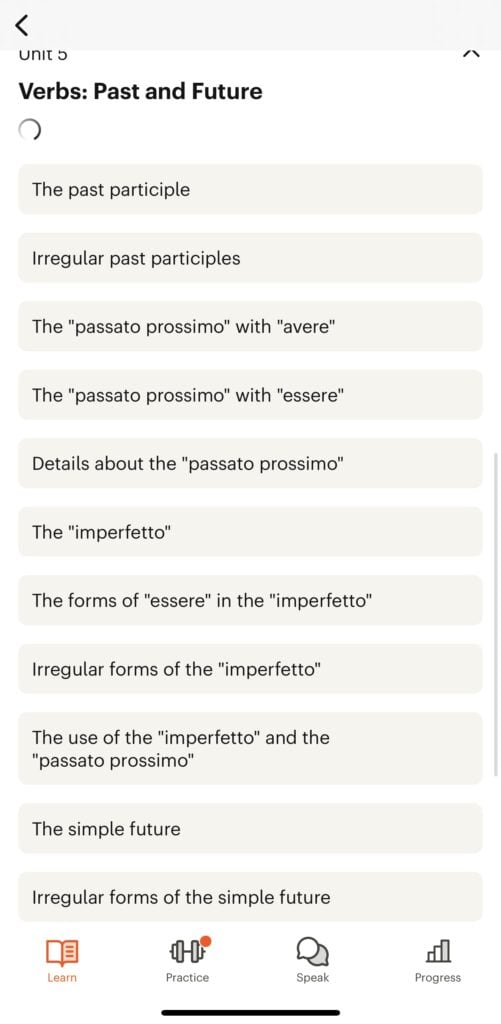
There’s even a unit on countries and traditions, which I love — it makes learning feel less like homework and more like cultural prep.
Babbel’s Speak feature + AI tools

The Speak feature lets you practice short conversations, so you’re not just learning about Italian — you’re using it. It’s low-stakes and super helpful for getting over the fear of sounding like a total mess when talking out loud to an actual Italian.
Babbel also recently added AI-powered conversation tools where you can explore specific topics or practice dialogues in a more dynamic way. It’s not perfect, but it adds variety and makes things feel more interactive than the usual app experience.

As you say the phrase and use the correct pronucation, you’ll see the speech bubble fill up with green color (see photo above). That makes practicing really fun and interactive.
In my opinion, Babbel’s AI tools are way better than competitors like MakesYouFluent, for example. Speaking of which, let’s dive deeper into a comparison….
😅 Tired of Duolingo’s weird phrases? Babbel teaches you what you’ll actually say in Italy — not how to talk to an owl about soup.
How Babbel Compares to Other Learning Tools
Babbel isn’t the only language app on the block — and trust me, I’ve tried most of them. (Yes, even Duolingo, where I spent way too long arguing with an owl about random vocab I’ll never use.) But Babbel stands out because it actually feels designed for those of us who want to use Italian in real life.
I also take 1-on-1 lessons through LanguaTalk, which have been amazing because having a personal connection with a tutor makes learning SO fun. But even with online classes, I realized I needed to practice Italian daily on my own time.
Learning a language takes motivation, consistency, and showing up for yourself. It takes more than spending two hours a week with a tutor.
And that’s when I started using Babbel for Italian. Here’s how I’d break it down:
| Tool | Best For | Weaknesses |
|---|---|---|
| Babbel | Structured practice, grammar, vocab | Less casual/immersive than convo |
| LanguaTalk | Live speaking practice | More expensive, needs scheduling |
| Duolingo | Gamified fun, keeping streaks alive | Lacks depth, weird phrases |
Babbel fills the gap between casual dabbling and full-on lessons. It gives me structure without stress, and enough repetition that I actually retain what I’m learning — something that most free apps don’t really offer.
Babbel actually explains why things work the way they do. You’re not just memorizing “Mi chiamo Jen” — you’re learning how verbs, pronouns, and grammar all fit together, slowly but clearly.
Real Progress I’ve Made After a Month

So here’s the part you’re probably wondering: Does Babbel actually work?
After a month of using it almost every day, I can confidently say… yes, it’s made a difference. I’m not out here giving TED Talks in Italian or anything, but I am finally starting to feel more comfortable with basic conversations. And that’s a big deal.
Before, I’d freeze when someone asked me where I was from or what I do. Now?
I can get through it without completely blanking. Babbel has helped me build a foundation of common phrases and sentence structures that I hear (and use) constantly, especially as an expat. And because I’m practicing daily, I’m starting to retain it.
- I’ve noticed I’m quicker to respond in everyday situations — at the café, the market, or chatting with neighbors.
- I’m finally internalizing verb conjugations and grammar points that used to bounce off my brain.
- I’m less intimidated to speak, because I’ve already practiced it in the app.
It’s not magic. But it’s progress. And for someone who lives in Italy and wants to feel like a functioning human in conversations, that’s huge.
Now, what is the “right” way to learn Italian? That’s going to look different for each person.
But, if I were to offer a suggestion, I think the best combination is practicing Italian with Babbel, watching Italian TV shows with Lingopie, and taking private tutoring classes on LanguaTalk. That way, you get some grammar practice, active and passive listening, and one-on-one instruction. Perfection!
Who Should (and Shouldn’t) Use Babbel for Italian

Babbel is, in my opinion, the best app to learn Italian, but it’s not one-size-fits-all. Here’s who I think Babbel actually works for.
👍 Babbel is great for:
- Expats living in Italy who need to function in daily life without spiraling into Google Translate
- Travelers who want to prep for a trip and use the language to order meals, ask directions, and have small talk
- Busy adults who need structure but don’t have time for long study sessions
- Beginner to intermediate learners (A1–B1) who want grammar explained simply and clearly
- People who need repetition to remember anything — like me 🙋♀️
🤷♀️ Maybe not ideal for:
- Advanced learners — there’s less content for higher levels, and it may feel too slow
- People who hate structure and prefer immersive chaos (which, to be fair, can work for some)
- Anyone expecting fluency from an app alone — Babbel’s great, but it shouldn’t be the only way you’ll learn Italian
If you’re serious about learning Italian, Babbel is an awesome part of your toolkit. Especially if you pair it with conversation practice, podcasts, YouTube vlogs, and actual human interaction.
FAQs About Learning Italian with Babbel
What is the best app for learning to speak Italian?
The best app for learning to speak Italian depends on your goals, but Babbel is one of the top choices for beginners and intermediate learners. It focuses on real-life conversations, grammar, and pronunciation with short, structured lessons that actually help you use the language, not just memorize vocab.
Can Babbel make you fluent in Italian?
Babbel can help you build a strong foundation in Italian, especially for everyday conversations, but it won’t make you fluent on its own. After a lot of personal experience practicing both Spanish and Italian, I’ve learned that fluency takes consistent practice, real-life speaking, and exposure beyond the app.
How long does it take to learn Italian with Babbel?
How long it takes to learn Italian with Babbel depends on your starting point and how often you use it. If you practice daily, you can make noticeable progress within a month. That said, reaching fluency can take several months to years, especially if you’re aiming for higher-level skills.
Babbel vs Duolingo: Which is better for Italian?
Babbel is better for learners who want structured grammar explanations and practical conversations, while Duolingo is more gamified and casual. If you’re serious about learning Italian for real-world use, Babbel has more depth and clarity — especially when it comes to grammar.
Can I use Babbel if I already take Italian lessons?
Yes, Babbel works great alongside Italian lessons. It’s actually one of the best ways to reinforce what you’re learning with a tutor. You can practice on your own time, focus on weak spots, and show up to your lessons with more confidence and vocabulary locked in.
Is Babbel worth it for travelers going to Italy?
Babbel is 100% worth it for travelers heading to Italy. It helps you learn practical phrases like ordering food, asking for directions, and introducing yourself — the stuff you’ll actually use while traveling. It’s quick, easy to stick with, and makes a big difference when you’re on the ground.
Will Babbel get you to C1 level?
Babbel won’t take you all the way to C1, which is an advanced level of fluency. The app is best for beginners and lower-intermediate learners (A1–B1). If you’re aiming for C1, you’ll eventually need more advanced resources, conversation practice, and possibly a teacher.
Final Thoughts: My Honest Babbel Italian Review

Is learning Italian with Babbel worth it? My answer is a solid YES! But realistic expectations.
It’s not going to magically make you fluent overnight. But if you’re consistent, it will help you build a real foundation in Italian. It’s perfect for learning everyday phrases, reinforcing grammar, and practicing conversations that you’ll actually use. Whether you’re living in Italy, prepping for a trip, or just trying to not panic when someone asks you where you’re from, it’s perfect for you.
I’ve made more progress in the past month with Babbel than I did in several weeks of hoping immersion alone would do the job. It fits into my day without stress — no scheduling, no pressure, just 10 minutes that actually helps.
Would I recommend it? 100%. Especially if you’re an expat, a beginner, or someone who just needs a structured way to get going. And if you’re already doing lessons with a tutor, Babbel is an awesome way to supplement and reinforce everything you’re learning.
🇮🇹 If you’re nodding along because you’ve been exactly where I was — feeling stuck, overwhelmed, and not-quite-fluent — Babbel might be the daily boost you need. It’s what finally made Italian feel doable for me.
Read More About Language Learning:
- How to Create a Language Learning Plan That Actually Works for You
- Learning Spanish for Travel: Phrases That Actually Help You Meet People
- 10 Best Language Learning Tools (That Actually Help You Speak the Language)
- I Tried Lingopie for 2 Weeks & Now I’m Spilling the Tea — A Lingopie Review
- I Took 50 Classes on Lingoda: My VERY Honest Lingoda Review
- Preply Review: 3 Years of Spanish Classes—The Honest Truth from a Student & Tutor
- Babbel Italian Review: 30 Days In, Would I Still Recommend It?
- I Practiced Spanish with Babbel Every Day for Two Weeks — An Honest Review
- Babbel vs. Duolingo: Which Language Learning App is Best for Travelers?
- Lingoda vs Preply: My Honest Take After Learning Spanish on Both
- MakesYouFluent Review: I Tried It for 2 Weeks—Here’s the Truth
Planning a trip right now? Here are a few top resources I use on every trip:
🏨 Booking.com for great deals on hotels.
🎟️ GetYourGuide for incredible tours around the world.
🌍 Faye for travel insurance with great customer support.
📞 eSIM for staying connected in the air, on a cruise ship, or exploring on foot.
🗣️ Babbel for brushing up on my language skills.
