

The Easiest Way to Learn Italian (From an American Living in Italy)
The easiest way to learn Italian isn’t necessarily the most intensive method or the one with the fanciest study plan. For me, it’s been the method I can *actually* stick with while juggling work, life, and everything else that fills up my day.
I’ll admit, I’m a bit of a busybody, hence the name, Jen on the Run.
Over the past year and a half, I’ve been learning Italian. I’ve tried pretty much everything: I’ve studied Italian at language schools in Sardinia and Florence, taken one-on-one online lessons, used language apps like Babbel, listened to podcasts and vlogs, and practiced in real life at grocery stores, restaurants, the dentist, the gym, and my coworking space.
I live in Italy. And that means I’m really lucky because I get opportunities to quickly realize which words I actually know and which ones have totally flown the coop and left my brain without notice 🐓🧠
But to be fully honest, even though I live in Italy…. I still need to do dedicated practice on my own time to really get the language to “stick.”
I’ve become a big believer in the path of least resistance. I try to make language learning EASY, above all else.
What I’ve come to realize is that the easiest way to learn Italian is to flop down on my couch and turn on my favorite Italian TV show.
And the tool I’ve been loving for this is Lingopie because it gives me dual subtitles. I can follow along in Italian and English at the same time. I haven’t found any other streaming platform that makes it quite as easy to watch a show, understand what’s happening, and pick up new vocabulary without constantly pausing to look things up.
Let’s dive into what Lingopie really is and why I think it’s 100% worth it if you’re learning Italian.

Lingopie for Learning Italian
Overall, I recommend Lingopie if you want to learn Italian (especially if you live outside of Italy!) because it gives you an easy way to hear real Italian regularly, even with a busy schedule. You can watch shows you’d probably watch anyway, use dual subtitles to follow along in Italian and English, and slowly build your listening skills and vocabulary from home.
The easiest way to learn Italian when you’re really busy
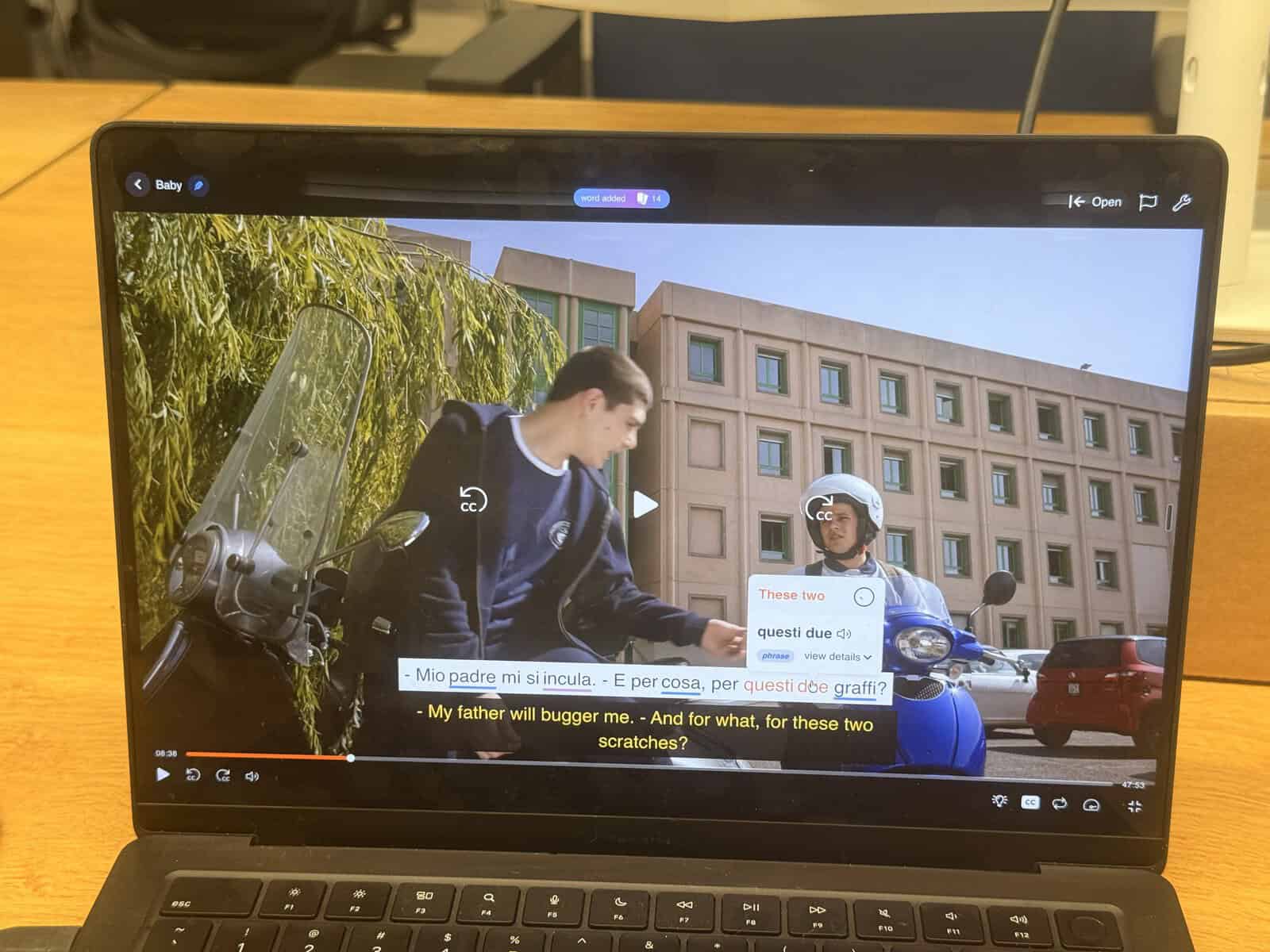
If you’re working full-time, juggling family stuff, traveling as a digital nomad, or just trying to keep up with normal life, finding an extra hour to study Italian every day might sound like a lot.
That’s why I’ve stopped trying to build the “perfect” language-learning routine and started focusing on what I can consistently do.
For me, that means aiming for at least 15 minutes of Italian every day and attaching it to something I’m already doing (i.e., the “habit stacking” theory from Atomic Habits by James Clear).
Basically, the less effort it takes to start, the more likely I am to actually follow through and ✨do ✨ the thing.
That’s a BIG reason Lingopie has worked so well for me. Instead of carving out a separate study session, I can turn on an Italian show while I’m eating dinner or winding down and still get listening practice, vocabulary exposure, and more time hearing Italian spoken naturally.
I personally believe that learning Italian doesn’t need to take over your schedule to be effective.
Sometimes the easiest way to learn Italian really is the one that is the most effortless, while still keeping you in contact with the language every day.
All the things I’ve done to learn Italian
I’ve tried a little bit of everything when it comes to learning Italian.
I’ve studied in person at language schools in Sardinia and Florence, taken one-on-one online classes, used apps like Babbel, listened to Italian podcasts and vlogs, and practiced whenever I can in everyday life.
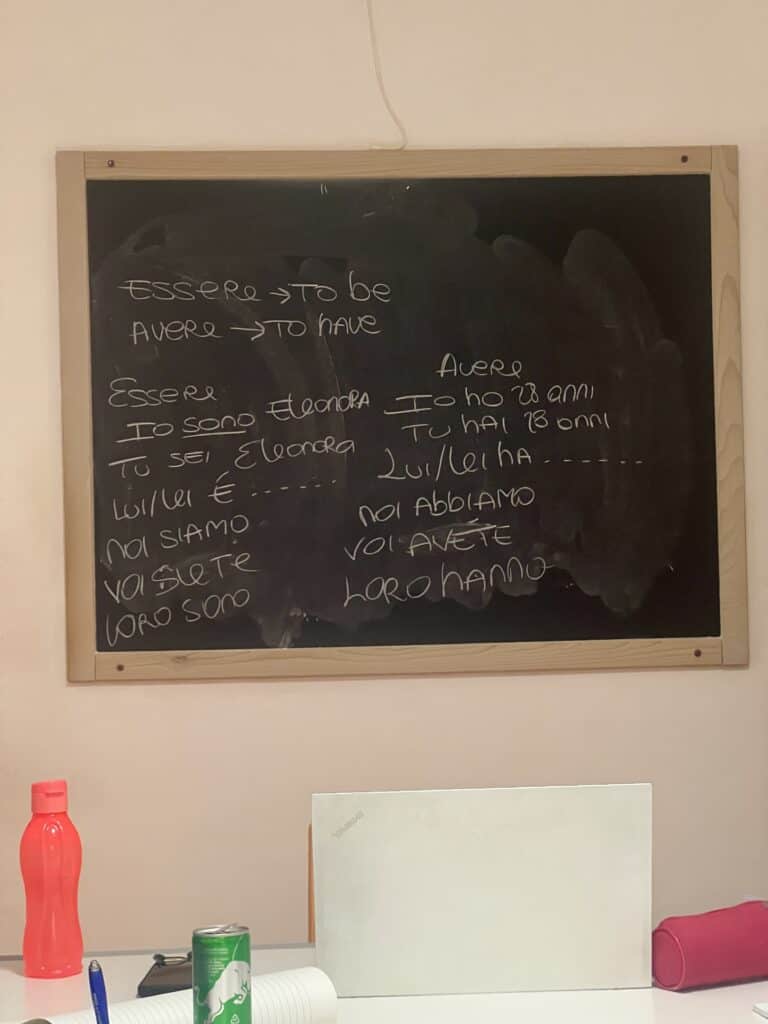
Living in Italy definitely gives me more opportunities to use the language, but they’re usually pretty random and inconsistent.
One day I’m at an aperitivo and getting along fine, and the next I’m trying to explain something at the dentist and suddenly realizing my vocabulary has some very specific gaps.
Of everything I’ve tried, I still think speaking with a very kind, patient native speaker is one of the best ways to learn Italian. You get immediate feedback, hear how people actually speak, and have to respond in real time.
The problem is that a native speaker with endless patience isn’t always available every night at 8 p.m. when I manage to find some free time to practice.
That’s why I don’t rely on one method anymore.
My Italian lessons and real conversations give me speaking practice, while Italian shows, podcasts, and tools like Lingopie help me fill in the gaps with listening practice in between those interactions.
Why watching Italian TV works so well for me
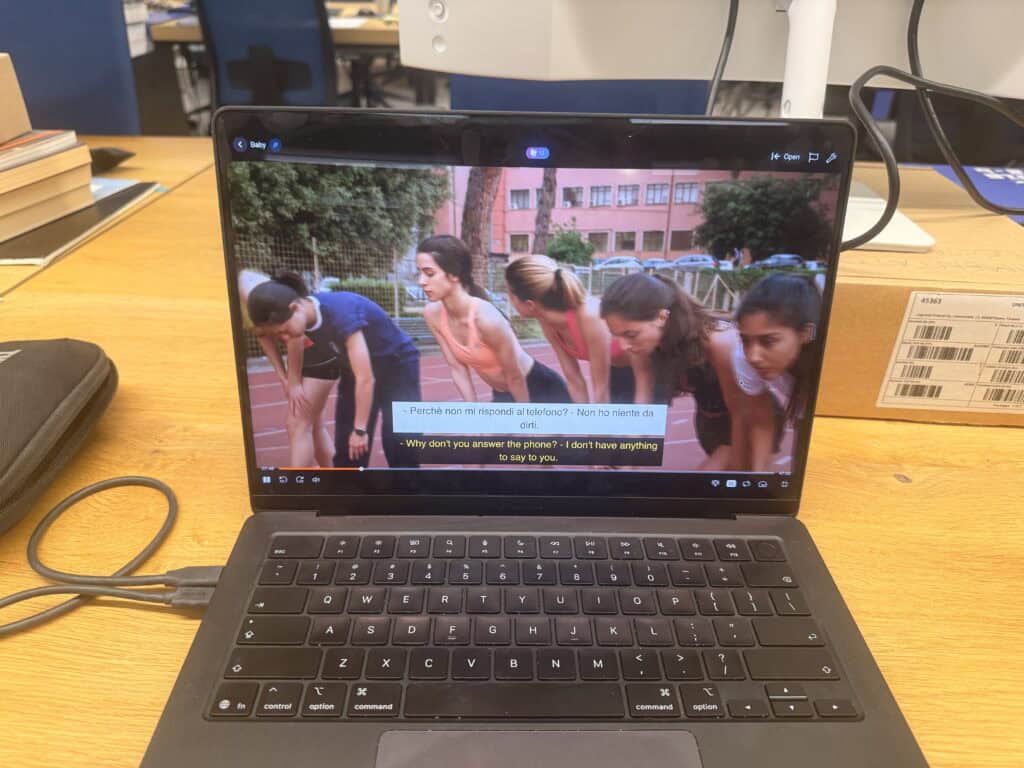
Watching Italian shows and movies with Lingopie has become one of my favorite ways to keep learning, and simply because it doesn’t really feel like studying.
I’m hearing natural pronunciation, picking up vocabulary in context from real speakers, and getting used to the rhythm of how Italians actually speak… all while watching a show I’d probably turn on anyway.
Lingopie has been so, so helpful. The dual subtitles make it way easier for me to follow along in Italian without completely losing the plot, and I can see the English translation when I need it.
That makes the whole experience way less frustrating than watching a regular streaming platform and constantly pausing to translate words I don’t know.
TBH, I used to do language practice in the morning with coffee in bed, but that routine pretty much disappeared when I brought my dog, Casper, from the U.S. to Italy.

Like most dogs, he wakes up ready to go for a walk ASAP like it’s an emergency. He has absolutely ZERO interest in my Italian study goals. So my mornings now mean an immediate walk 😄 🐶
So now, because my schedule shifted a bit thanks to the pup, I usually spend my dedicated Italian time in the evenings when I’m eating dinner.
Since I live alone and eat by myself most nights, it’s an easy way to turn that time into language practice without adding another chore to my day.
My favorite shows are Baby (a show about the drama rich kids get up to in Rome) and The Law According to Lidia Poët (about Italy’s first female lawyer).
I use Lingopie’s Google Chrome plugin, which connects to Netflix so I can watch these shows and get the dual subtitles while watching. It’s seriously a game changer.
Is Lingopie a good way to learn Italian?
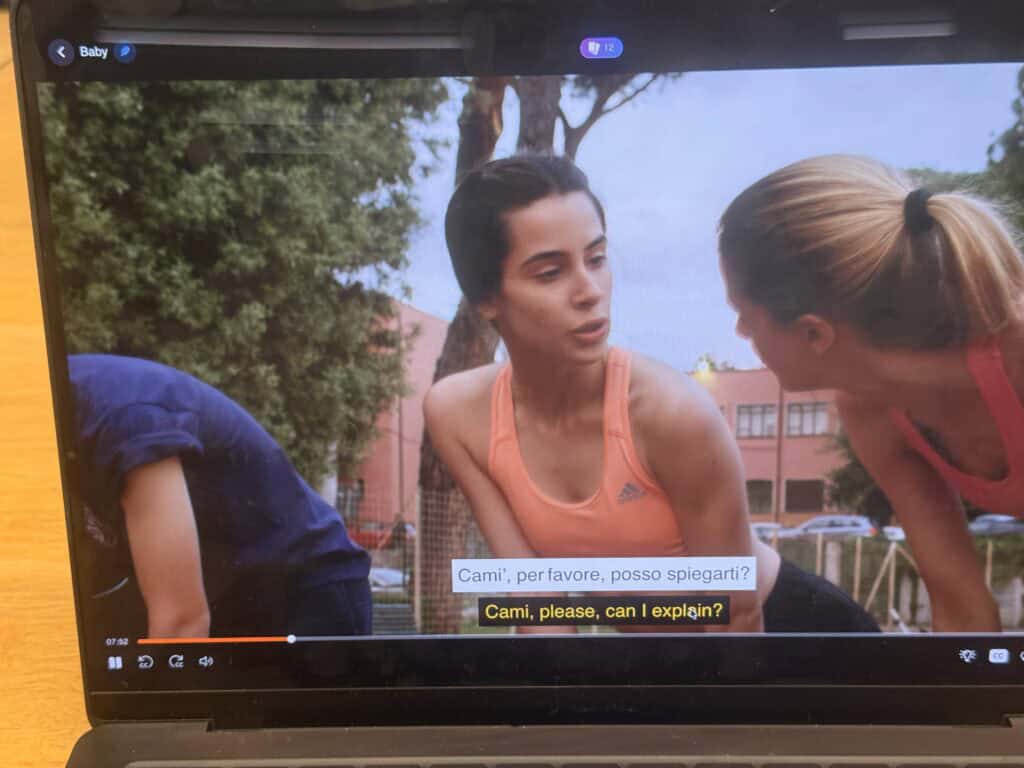
I think Lingopie is especially useful if you already like watching TV and need more listening practice.
Unlike a regular streaming platform, it’s built specifically for language learners, so you can watch Italian shows with Italian and English subtitles at the same time, click unfamiliar words for instant translations, replay individual lines, and even slow down the playback when everyone suddenly starts speaking super fast.
You can also save vocabulary for later, hear the pronunciation of individual words and use Lingopie’s Grammar Coach to get explanations based on the actual sentence you just heard.
I like that feature a lot! It helps to see it in the context of a situation that’s playing out on screen.
For me, the biggest benefit of Lingopie is that it removes a lot of the friction. On a normal streaming platform, I’d have to pause the show, look up a word somewhere else, try to figure out the grammar and then remember what was happening in the scene.
With Lingopie, most of that happens right inside the player. Easy!
That said, I wouldn’t use Lingopie as my only way to learn Italian. It’s strongest for listening comprehension, vocabulary, pronunciation and getting more comfortable with natural speech.
You’ll still want real conversations, lessons or other speaking practice if your goal is to actually talk to people without freezing the second they answer you back.
FAQs about learning Italian
What is the easiest way to learn Italian?
The easiest way to learn Italian is to build it into your life in a way that feels realistic. For me, that means getting at least 15 minutes of exposure a day through shows, podcasts, lessons, or real conversations instead of waiting until I have a huge block of free time.
Can you learn Italian by watching TV?
Watching Italian TV can help a lot with listening comprehension, vocabulary and getting used to how native speakers actually sound. And if you live outside Italy, I think this kind of exposure is huge because you may not have Italian speakers around you every day.
That’s one reason I like Lingopie so much. It gives you regular access to native Italian content while also giving you support through dual subtitles, clickable translations, and replay tools, so you’re not just sitting there understanding approximately three words per episode and calling it immersion.
How much Italian should I practice every day?
I’d aim for at least 15 minutes a day. You can absolutely do more, but I think a short daily habit is much easier to maintain than studying for two hours once a week and then disappearing from the language for six days.
What is the best way to practice speaking Italian?
In my experience, speaking with a patient native speaker is hard to beat. A tutor, language exchange partner, or real-life conversation forces you to form your own sentences instead of just recognizing Italian when you hear it.
If you live outside Italy, you may need to be a little more intentional about finding those opportunities. That’s where online lessons can help, while tools like Lingopie keep your listening practice going between conversations.
The best way to learn Italian is the way you’ll stick with

After studying IRL at language schools, taking lessons 1-on-1 online, using language learning apps, and now living in Italy, I’ve realized there really isn’t one “perfect” way to learn Italian.
The best way to learn Italian is the one you’ll actually keep doing, even when work is busy, even when you’re tired, and especially when you don’t feel like it.
For me, Lingopie helps me get to that sweet spot. I can get exposure to real Italian on my schedule, pick up vocabulary, and work on my listening comprehension while doing something I already enjoy…. watching TV!
And especially if you’re learning Italian from outside Italy, I think having that regular access to native speakers and natural conversation is even more valuable because you’re not necessarily hearing Italian every time you step out of the house, like me.
You’ll still need to speak, make mistakes, and practice forming your own sentences in Italian. But if watching an Italian show for 15 or 20 minutes is what gets you exposure to the language every day, that counts and it’s crucial to picking up the language.
If you’re looking for a low-pressure way to add more Italian to your day, I’d wholeheartedly recommend giving Lingopie a try and seeing whether it fits naturally into your routine.
If you’re still on the fence about trying Lingopie, check out my full review, where I get into the nitty-gritty of all its features.
Read More About Language Learning:
- The Easiest Way to Learn Italian (From an American Living in Italy)
- How to Create a Language Learning Plan That Actually Works for You
- Learning Spanish for Travel: Phrases That Actually Help You Meet People
- 10 Best Language Learning Tools (That Actually Help You Speak the Language)
- I Tried Lingopie for 2 Weeks & Now I’m Spilling the Tea — A Lingopie Review
- I Took 50 Classes on Lingoda: My VERY Honest Lingoda Review
- Preply Review: 3 Years of Spanish Classes—The Honest Truth from a Student & Tutor
- Babbel Italian Review: 30 Days In, Would I Still Recommend It?
- I Practiced Spanish with Babbel Every Day for Two Weeks — An Honest Review
- Babbel vs. Duolingo: Which Language Learning App is Best for Travelers?
- Lingoda vs Preply: My Honest Take After Learning Spanish on Both
- MakesYouFluent Review: I Tried It for 2 Weeks—Here’s the Truth
Planning a trip right now? Here are a few top resources I use on every trip:
🏨 Booking.com for great deals on hotels.
🎟️ GetYourGuide for incredible tours around the world.
🌍 Faye for travel insurance with great customer support.
📞 eSIM for staying connected in the air, on a cruise ship, or exploring on foot.
🗣️ Babbel for brushing up on my language skills.
