
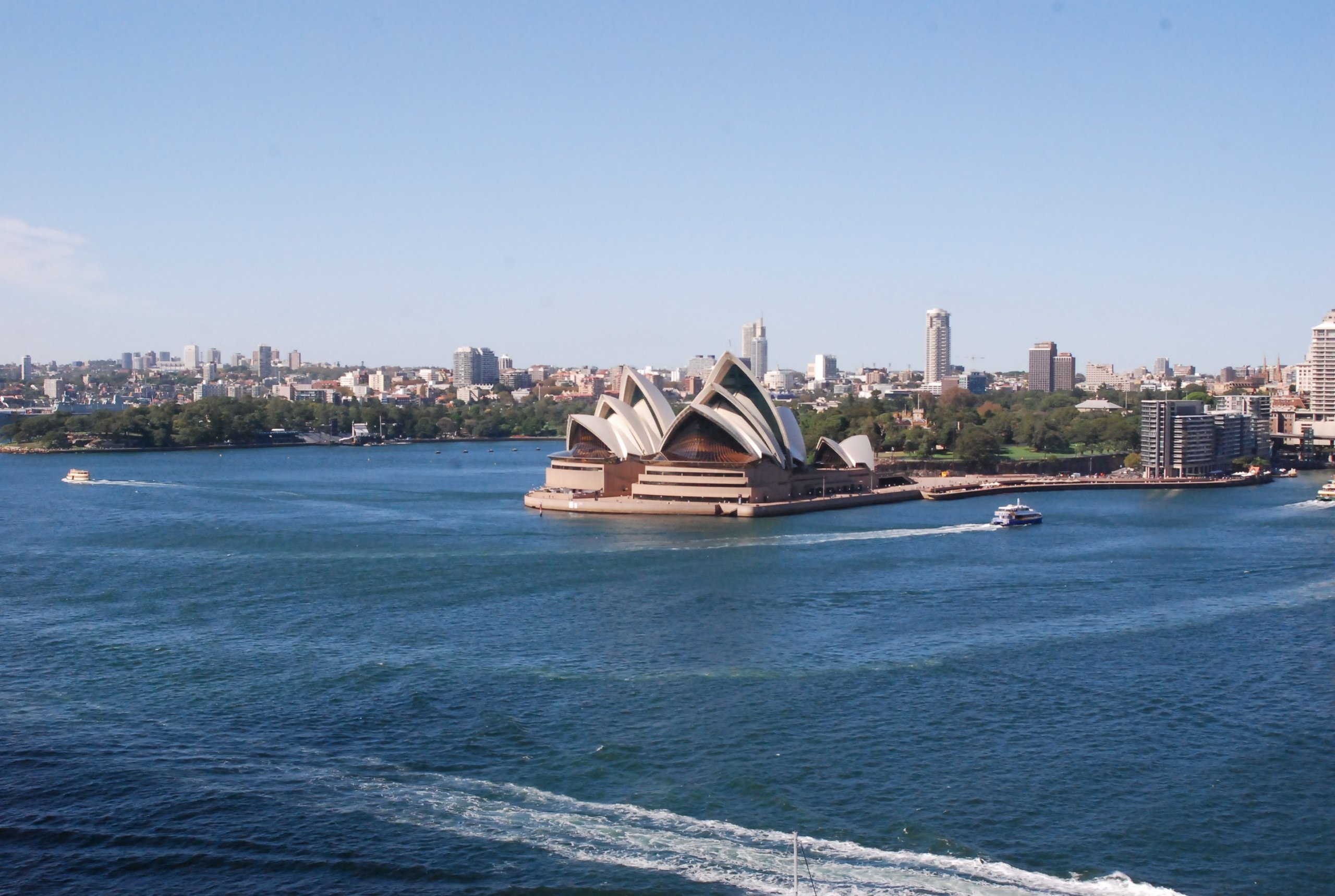
The Iconic Sydney Opera House
When I was younger, I always wondered if I’d ever make it to Sydney, Australia. A destination like Italy or Spain seemed far away yet much more attainable, since I have distant relatives living in Europe. But Sydney? I saw the Opera House on TV every year on New Year’s Eve, as the city is always one of the first in the world to welcome in the new year. Memories of fireworks come to mind, colorful blasts of light in the sky above the white billowing rooftop of the opera house. Would I see it in person during my lifetime? Or would it be one of those places I’ll hear about my entire life, but never really know what it’s like to be there?

Well, you guessed it – I made it. By my good fortune, my lifelong friend, Laura, moved to Sydney with her husband just over one year ago. Luckily, our mutual friend Kirstin had just finished medical school and was ready for some international travel. Another stroke of luck landed us with “mistake” pricing on airfare, which happens when an airline accidentally makes a typo on the cost. We got round-trip tickets from Los Angeles to Sydney for merely $688 (normally $1,300+). And luckily, I had subscribed to Scott’s Cheap Flights just a few months before, which notified me of the deal. Truly, this trip was meant to be.
After 15 hours of travel, Kirstin and I arrived at Circular Quay in Sydney. The most spectacular morning view of the Sydney Opera House awaited us, since we had to hop on the ferry towards North Sydney. If you’re looking for an epic view of the opera house by water, be sure to take a ferry during your stay here! In the foggy morning light, I was actually shocked to see that the rooftop of the opera house isn’t actually pure white at all. In fact, it appears to be quite yellow looking, which I presumed was from years of wear and pollution, and the building itself is much smaller than I imagined. But don’t get the wrong idea, I wasn’t disappointed in the slightest – rather, I was in awe of the “realness” that being there in person always brings.
 The next day, during our tour of the Sydney Opera House, I learned that the rooftop tiles actually can’t be pure white at all, otherwise the reflection of the sun on white tiles would be so bright, it’d probably blind you from a distance. Smart design!
Through the rest of our tour, I learned so much about the history and formation of this cultural center that I’d never known before. First off, as you can imagine, the opera house is architectural eye-candy. If you’re a die-hard architecture and design lover, you absolutely must add the Sydney Opera House to your bucket list.

How did this inspiring structure come to be? Surprisingly, its history is filled with controversy. In 1957, an international design competition was held calling for proposals. One of the designers who submitted a proposal was Jørn Utzon, a Danish architect based in Hellenbaek, just north of Copenhagen. Utzon’s design was one of more than 233 entries received from 28 countries. I was surprised and delighted to learn that one of my favorite modernist designers, Eero Saarinen, known for designing the infamous Womb Chair and the Gateway Arch in St. Louis among many more landmarks, played a major role in the selection and implementation of Utzon’s Opera House design.

In January 1957 it was announced that Utzon’s design was the winner: “Because of its very originality, it is clearly a controversial design. We are however, absolutely convinced of its merits.”

With a view like this, how could you go wrong? In our day and age, it’s easy to see the merits of Utzon’s design, but I can also imagine the questions skeptics must have had during that time period. Such an unusual structure! So unlike most architectural structures the world had seen up until that point.
Controversy continued during the Opera House’s construction. How on earth were the engineers going to actually build Utzon’s shell-shaped roof design? It took the course of four years and several revisions, but the groundbreaking architectural discovery finally came to be. Utzon and his team explored parabolic, ellipsoid and lastly, spherical geometry to create the form of the shells. Ultimately, the discovery that the shells could be made from the surface of a sphere, coined “The Spherical Solution,” became a major landmark in 20th century architecture.


Despite the groundbreaking discovery of how to construct the shells, controversy continued when the political climate changed in 1965. Concerned with increasing costs associated with the Opera House, the government declared that Utzon would only be paid after producing drawings. Yet Utzon could only create those drawings after building a prototype that would test if plywood beams (instead of steel beams) would support the glass walls of the Opera House. And so, payment to Utzon abruptly halted, essentially forcing him to resign.

The public outcry to Utzon’s resignation was massive. More than 1,000 people marched through the streets demanding that Utzon be reinstated, yet sadly, Utzon was never asked to return and finish the project. Instead, architect Peter Hall completed work on the project, and the Sydney Opera House celebrated its grand opening on October 20th, 1973.
 Nowadays, the Sydney Opera House hosts over 1,500 performances annually through Opera Australia, the Sydney Theatre Company and the Sydney Symphony Orchestra. This incredible, awe-inspiring structure is a UNESCO World Heritage Site More. More than 8 million people visit the Sydney Opera House every year, and I was lucky enough to be one of them!
 Utzon’s story does have a silver lining, though: The Sydney Opera House Trust aimed to reconcile with Utzon, and in the late 1990s, he was asked to be involved as a consultant to help plan the building’s future. In his honor, the first interior space rebuilt to an Utzon design was opened and was given the name, “The Utzon Room.” The room also showcases a floor-to-ceiling woolen tapestry designed by Utzon himself. After receiving the tribute to his work, Utzon said: “It gives me the greatest pleasure and satisfaction. I don’t think you can give me more joy as the architect. It supersedes any medal of any kind that I could get and have got.” He continued consulting until his death in 2008, and his son, Jan Utzon, continues to be involved in the Opera House’s future.
What do you think – does the Opera House’s troubled past give you mixed feelings? Or should we “let bygones be bygones” and the reconciliation attempts with Utzon were enough? Let me know your opinions in the comments!
Interested in more posts about Australia? Check out the top bars and restaurants in Melbourne.
